




IN-HOUSE CFD CODE
The CFD work-horse of our group is a high-end Navier Stokes code for solving hypersonic flow problems with turbulence and hightemperature effects. Many canonical configurations are amenable to two-dimensional or axisymmetric simulation. Full three-dimensional version with structured multi-block grids is used for practical geometries.
Turbulent reacting flow simulations are done using the Reynoldsaveraged approach. The code also has Hybrid RANS-LES capability in the form of Detached eddy simulation. DES is mostly used for flows around re-entry capsules with massive separation behind them. Finite rate thermo-chemistry models are included for simulating chemically reacting flows with non-equilibrium effects.
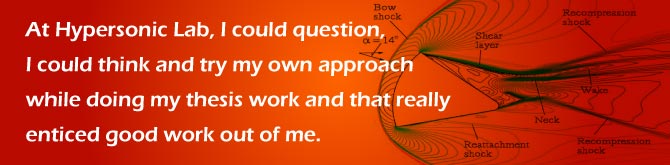
The main advantage of the in-house CFD code is its low dissipation Steger Warming method that is used for the inviscid flux calculation. This approach has been proved to be robust and accurate for some of the toughest flow problems. An example is the flow over a double-cone geometry with strong viscous-inviscid interactions.
Another key feature of the code is the implicit time integration using the Data Parallel Line Relaxation approach. It allows large time steps (CFL upto 10000) and a rapid convergence to the steady state solution, even for complex flow configuration.
The code is fully parallelized using Message Passing Interface. A distributed memory implementation is used where a given flow domain is broken down into smaller zones. Each zone is solved on a different processor core and information is exchanged at zone interfaces several times during each time step.
COMPUTATIONAL HARDWARE
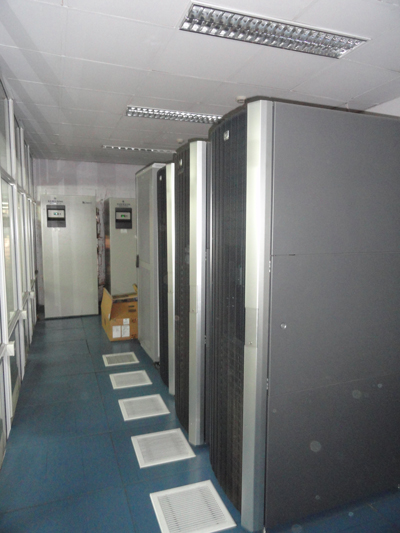
A dedicated HPC linux cluster, along with its peripheral infrastructure for precision cooling and power backup is set up for the hypersonic CFD simulations. It has 40 compute nodes totaling to about 200 processor cores. The Rocks software suite manages the job queues and resource allocation with online web-based monitoring. An independent I/O node is available for post-processing and visualization of the simulation data.
A low latency Myrinet switch is found to be essential to achieve high parallel scale up of the simulations. It allows rapid data transfer between compute nodes of the cluster, and is particularly suited for situations where there is frequent data transfer between nodes.
LAB FACILITIES
- Multi-block grid generation using Gridgen.
- Flow visualization and analysis using Tecplot.
- Full power backup of all hardware.
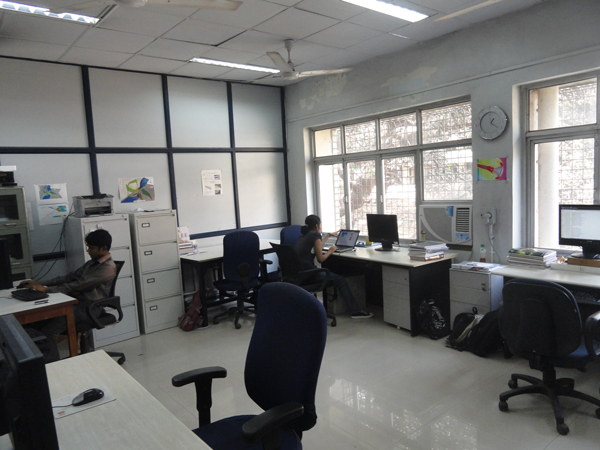
- High-end graphics workstations for pre- and post-processing CFD data.




 Pratikkumar Raje gave his Ph.D. Defence on "Advance two equation turbulence models for computing shock-dominated flows in aerospace applications” on 2nd December, 2021.